

From Bundled to Better: Rethinking Plan Administration From a financial management perspective, it...
Pre-Tax Vs. After-Tax: Why Nonqualified Deferred Compensation Plans Remain Powerful – Even in a Low-Turnover Portfolio Environment


A common refrain among senior executives is that “a well-managed, low-turnover taxable
portfolio can outperform deferring income.” The logic sounds reasonable: minimize realized
gains, manage capital gains taxes efficiently, and maintain liquidity and flexibility. However, when the math is fully explored across varying turnover assumptions, tax regimes, and retirement outcomes, deferring your compensation pre-tax yields higher returns.
The following modeling materials and graphics demonstrate a clear conclusion: tax rates at
distribution would need to reach extraordinarily high levels to eliminate the economic
advantage of deferring income into a nonqualified deferred compensation (“NQDC”) plan.
Our findings explain why deferral remains a dominant wealth accumulation strategy, even for
executives with disciplined after-tax investing behavior and favorable retirement tax geography.
To understand why this advantage persists, it is necessary to examine the structural engine
behind deferral.
The Core Advantage: Pre-Tax Compounding
The primary driver of NQDC value is not investment selection or market timing, it is the ability to compound pretax dollars over long-time horizons.
When income is deferred:
-
100% of the gross compensation is invested
-
Taxes can be postponed for decades
-
Earnings compound without annual tax drag
By contrast, taxable investments, even with low turnover, starts with a reduced capital base and experiences ongoing leakage from dividends, interest, and unavoidable realizations.
The NQDC plan modeling below assumes a conservative but realistic structure:
-
Deferrals of $100,000 beginning at age 45 through age 64
-
Retirement at age 65
-
10 distributions beginning at retirement
-
Long-term earnings rates between 5%–10%
-
Assumed Portfolio Turnover: 50%
-
37% Individual Tax Rate, 20% Long-Term Capital Gains Tax Rate, 3.8% Net Investment Income Tax (“NIIT”) associated with taxable securities
Across every modeled return environment, pretax deferral creates a compounding advantage that is extremely difficult for taxable portfolios to overcome.
Exhibit A
Cumulative After-Tax Benefit - No State Income Tax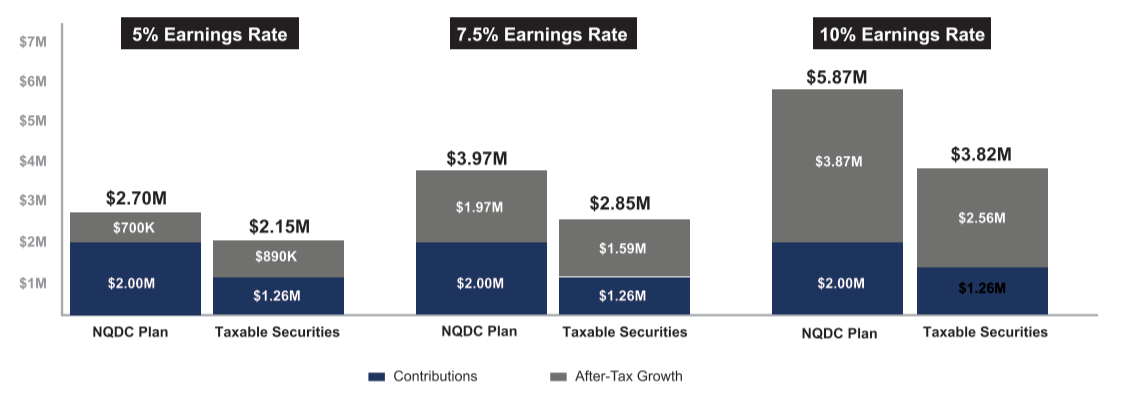
Despite this compounding advantage, many executives believe it disappears once portfolio
turnover is minimized.
The Misconception Around Low Turnover
Executives often argue that “my portfolio turnover is very low, so my tax drag is minimal.” While lower turnover certainly improves tax efficiency, the data shows it is not sufficient to neutralize the benefit of deferral.
The graphic in Exhibit B compares NQDC plan outcomes to taxable portfolios under varying turnover assumptions reveal:
-
Even at very low turnover, NQDC plans maintain a meaningful after-tax advantage
-
As turnover increases, the NQDC plan advantage accelerates dramatically
In a no state income tax retirement scenario, cumulative after-tax advantages of deferral range from:
-
Approximately 20% at zero turnover
-
To more than 65% at higher, but still realistic, turnover levels
When state taxes are present during accumulation, or only during working years, the advantage becomes even more pronounced.
Exhibit B
Cumulative After-Tax Benefit - No State Income Tax
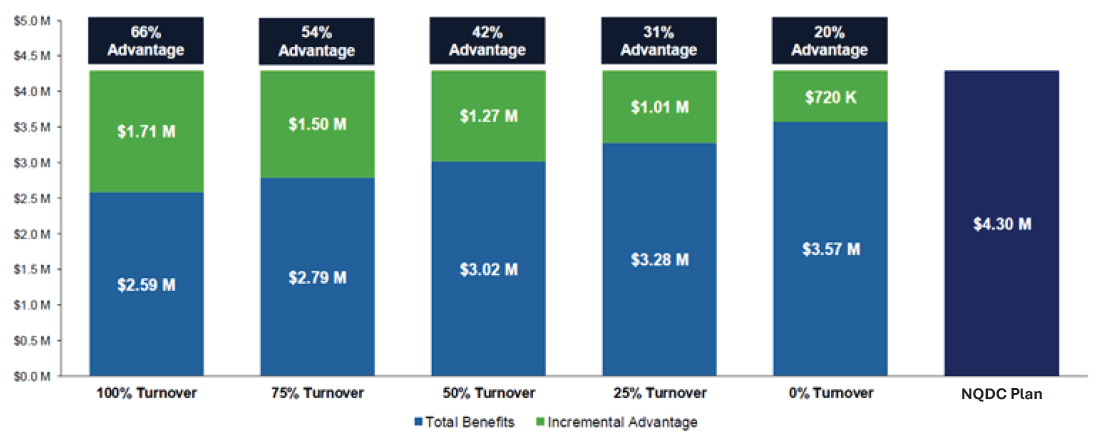 Note: Assumes participant age 45, retirement age 65, $100,000 annual deferral for 20 years, 10 payouts, 8% earnings rate, 37% tax rate, 20% long-term capital gains tax rate and 3.8% Net Investment Income Tax (NIIT).
Turnover efficiency alone does not determine outcomes—tax geography often proves
decisive.
State Taxes: Often the Tipping Point
One of the most overlooked dynamics in this analysis is state income tax arbitrage.
Many executives:
-
Earn compensation in high-tax states (e.g., NY, CA)
-
Retire in no-tax states (e.g., FL, TX, TN)
The modeling (Exhibit C, Page 4) explicitly incorporates this reality.
When state taxes apply only during working years,1 and distributions occur in a no-tax
jurisdiction:
-
The cumulative after-tax advantage of deferral can exceed 100% compared to
taxable investing -
In certain scenarios, deferral produces more than double the after-tax wealth
accumulation
This directly offsets the argument that low-turnover taxable portfolios “win” due to capital
gains efficiency.
Exhibit C
Cumulative After-Tax Benefit - 12.1% State Income Tax Until Retirement
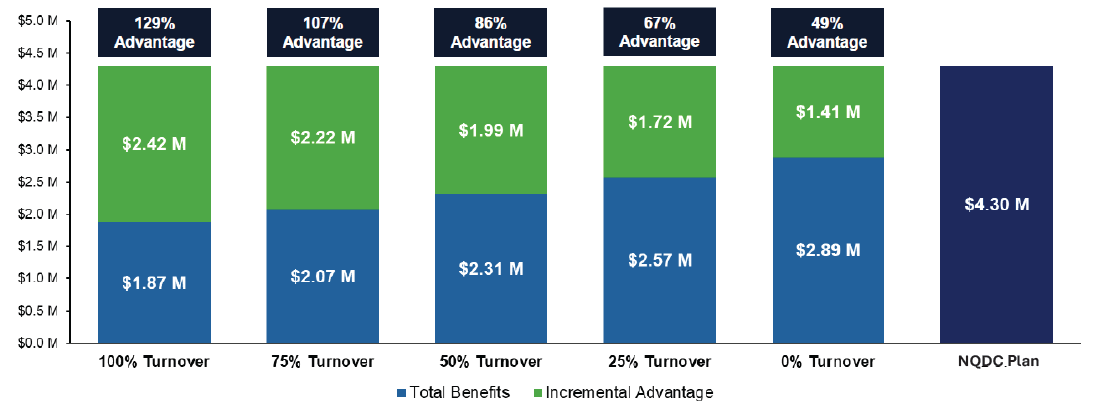
Note: Assumes participant age 45, retirement age 65, $100,000 annual deferral for 20 years, 10 payouts, 8% earnings rate, 37% tax rate, 20% long-term capital gains tax and 3.8% Net Investment Income Tax (NIIT). Modeling assumes an additional 12.1% state tax (average of New York and California state tax) through age 64.
This analysis raises a more fundamental question: how extreme must tax policy become to reverse the advantage of deferral? To answer that question, the analysis turns into a direct tax-rate stress test.
How High Would Tax Rates Have to Go?
The table on the following page (Exhibit D) illustrates the retirement tax rate required to
eliminate the benefit of deferral, assuming:
- Retirement at age 65
- 15 distributions
- Earnings rates between 5%–10%
The results are eye-opening:
-
For executives deferring at age 45 with an 8% return assumption, tax rates would need to approach approximately 70%
-
At higher returns or longer deferral horizons, required tax rates can exceed 70%.
These are not marginal differences. They are historically unprecedented, economically
destabilizing tax levels.
In other words:
Tax rates would have to become extraordinarily punitive before deferring income ceases to make sense.
Exhibit D
Value of Deferring Income
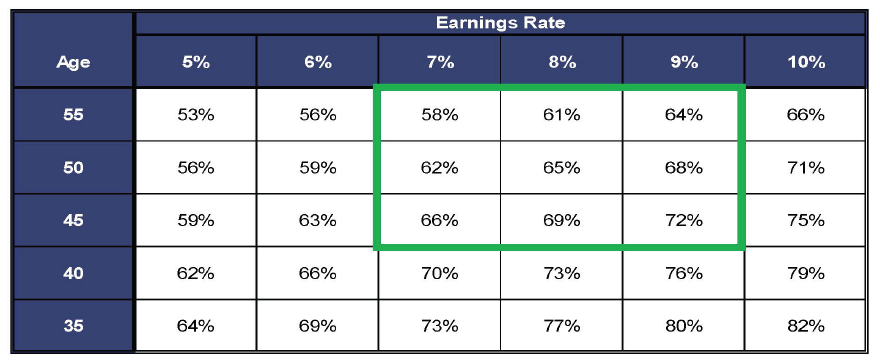
Note: Pre-retirement tax rate assumes a 37% Federal income tax rate and a 3.8% tax on investment income associated with healthcare reform legislation. Assumes deferrals / contributions made through age 64.
Even if tax rates never rise, taxable portfolios still have a built-in disadvantage.
Return Equivalency: What Taxable Portfolios Must Overcome
Another way to frame the analysis is return equivalency.
Exhibit E (Page 6) modeling illustrates the additional return a taxable portfolio must
generate to match an 8% NQDC plan return. Depending on portfolio turnover, taxable
portfolios must outperform by 16%-69%, Consistently achieving this level of outperformance is
exceptionally unlikely, particularly over multi-decade horizons.
Exhibit D
Return Equivalency of Taxable Securities vs. Deferring Income
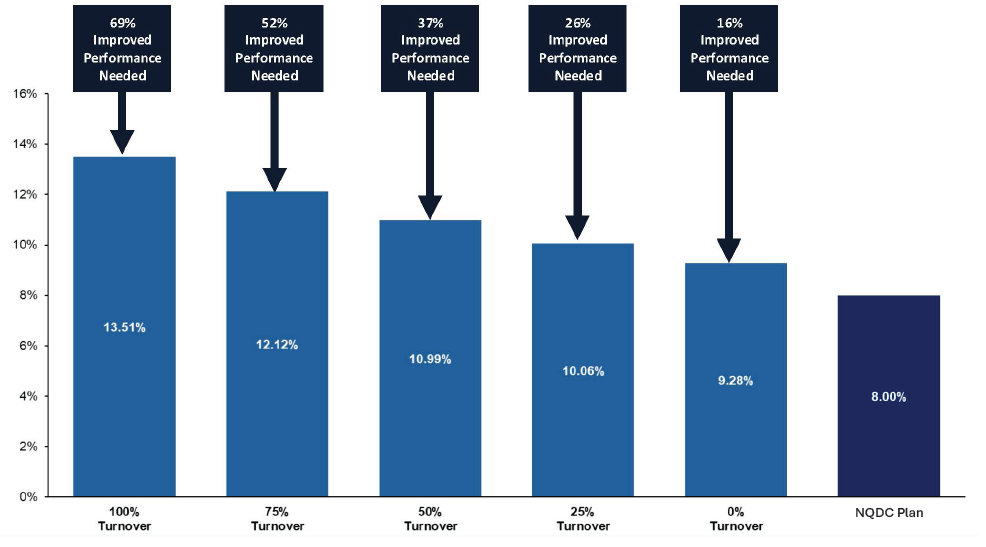
Note: Assumes participant age 45, retirement age 65, $100,00 annual deferral for 20 years, 10 payouts, 8% earnings rate. 37% tax rate, 20% long-term capital gains tax rate and 3.8% Net Investment Income Tax (NIIT).
When turnover, geography, and return requirements are considered together, the conclusion is consistent.
Turnover + Geography: Why Advantage Persists
Once distributions begin, taxes apply to a much larger accumulated base, but that base exists only because deferral allowed it to grow faster in the first place.
NQDC plans outperform taxable securities even in scenarios most favorable to taxable investing:
-
Low turnover
-
Long-term capital gains treatment
-
Retirement in a no tax state
The compounding benefit of pretax deferral remains substantial.
This is why focusing solely on payout tax rates misses the broader picture.
Advantage Deferral Is a Math Problem, Not a Market Bet
The belief that a low turnover after-tax portfolio can routinely outperform a pre-tax wealth
accumulation strategy is more narrative than math.
The data indicates:
-
Deferral wins across a wide range of market returns
-
Deferral wins across turnover scenarios
-
Deferral wins even when retirees relocate to tax friendly states
-
Tax rates would need to be extremely high to negate the advantage of deferring.
NQDC is not about predicting markets or tax policy—it is about maximizing the capital base
that compounds for decades.
For executives evaluating how to allocate excess compensation, the conclusion is evident:
Deferring income remains one of the most powerful, resilient, and underappreciated
wealth-building tools available—especially when viewed through a long-term, after-tax
lens. When evaluated on the basis of long-term after-tax outcomes, deferral remains the
dominant wealth accumulation strategy for excess compensation.
1 New Jersey is the only state where state taxes apply on distributions even if you are in a different state.
For illustrative purposes only. Modeling assumptions derived from Mezrah Consulting analyses.