
Loan Regime Split-Dollar
A Different Approach to the Split-Dollar Strategy.
Provide your contact information you would like to learn more about!
What is a Loan Regime Split-Dollar Plan?
A loan regime split-dollar plan is a type of split-dollar life insurance arrangement where an employer lends money to an employee to pay for a life insurance policy premium. The employee still owns the policy and gives the employer an interest in it as collateral. The employer pays the premiums, which are considered loans from the employer to the employee.
How a Loan Regime Split-Dollar Plan Works
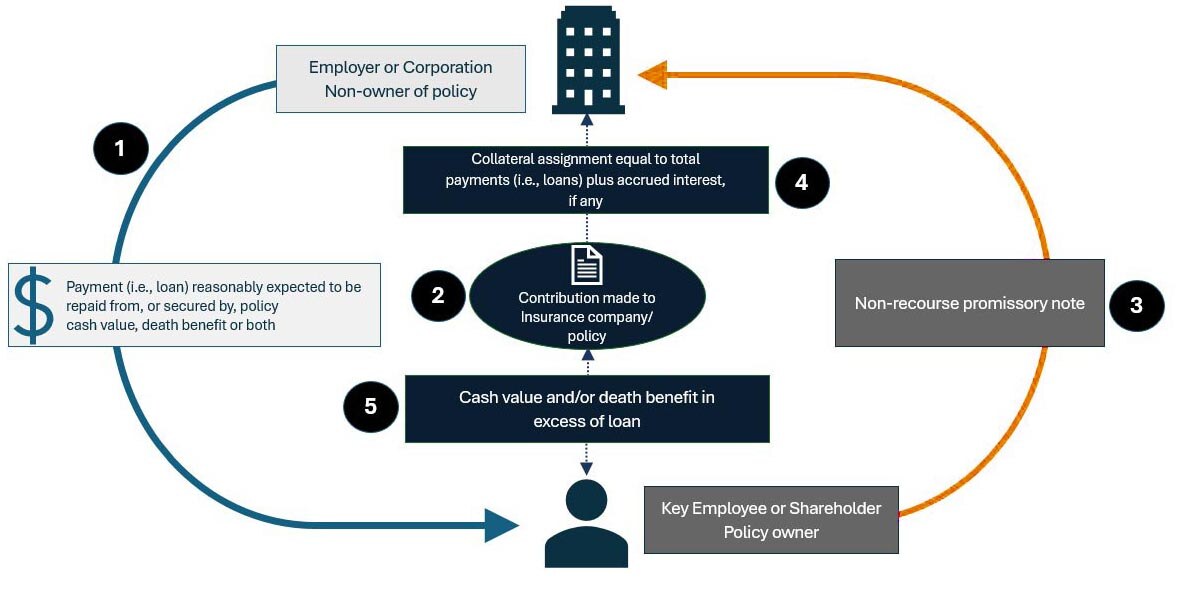
Hypothetical example only.
- The employer establishes a split-dollar agreement with the employee. The employer owns the policy and agrees to endorse a portion of the death benefit to the employee’s beneficiaries.
- The employer pays the premiums to the insurance company on the life of the employee.
- The employee is taxed on the value of the “economic benefit” of the policy, equal to the value of a term life policy with an equivalent death benefit.
- If the employee passes away - the employer receives the death benefit at least equal to the policy’s cash value.
- The employee’s beneficiaries receive the employee’s portion of the death benefit, federal income tax free.
The net premium expense is the cost associated with the remaining $50,000 of group term coverage per participant.

Note: Assumes 80 participants, average executive age of 52, average executive salary of $250,000, current group term life insurance (GTLI) cost per $1,000 of benefit of $0.062,
proposed Split-Dollar benefit amount of 2x salary less $50,000 of group term, 3% annual growth on group term life annual premiums and a 26.5% corporate tax rate.
Hypothetical results are for illustrative purposes only and are not intended to represent the past or future performance of any specific product.