

A common refrain among senior executives is that “a well-managed, low-turnover taxableportfolio can...
True Cost of Losing an Executive - 2026 Edition


We first explored the true cost of losing an executive several years ago. Since then, the business and leadership environment has continued to evolve. With new data providing a more current view of executive turnover, workforce retention and organizational disruption, we wanted to revisit the conversation and update the data behind an issue that remains important: understanding what a company may really lose when a key executive leaves.
Many companies tend to be myopic as it relates to understanding the true cost of losing an executive. It is important for companies to focus on the “total” costs that will accompany the loss of an executive, particularly an extremely talented executive.
The True Cost of Losing an Executive
 Obvious Costs (Fixed)
-
Recruiting, Interviewing, and Hiring Process
- Administrative Costs
Hidden Costs (Variable) - Lost Productivity
- Orientation and Onboarding
- Long-Term Training
- Potential Customer Dissatisfaction
- Increased Errors
- Reduced or Lost Business
- Lost Expertise
- Employee Morale
- Company Culture
- Employee Disengagement
The real cost of executive turnover is, for the most part, an unknown. This is largely because most companies don’t have systems in place to track exit costs which can include the following:
- Interviewing
- Hiring
- Orientation
- Training
- Lost productivity
- Potential customer dissatisfaction
- Reduced or lost business
- Administrative costs
- Lost expertise
- Recruiting
Collaboration between two or more departments on any issue can be challenging, especially
when departments like HR, Finance, and Operations all need to collaborate to develop tools and processes that measure these costs concomitant with reporting mechanisms.
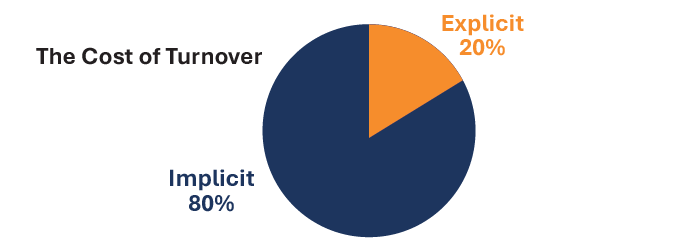
Traditionally, most people think that the costs of losing an executive are just “explicit” costs, such as firm fees to find a replacement. However, the more impactful costs are often the “implicit,” or opportunity costs. Together, explicit and implicit costs reflect the true cost of losing an executive which can be approximately 200 - 300 percent of the executive’s salary.
Published turnover estimates can provide a starting point, but no single percentage will accurately represent every executive departure. The actual cost depends on factors such as the executive’s responsibilities, compensation, tenure, relationships, specialized knowledge and importance to the company’s long-term strategy.
Recent data shows that executive turnover remains a material business consideration. Russell
Reynolds Associates reported 234 CEO departures across the global indices it tracked in 2025,
a 16% increase from 2024 and 21% above the eight-year average. In the S&P 500 alone, 59 CEOs departed in 2025.1
While CEO turnover does not represent every executive role, it provides a current indicator of the level of leadership movement organizations are navigating. Broader workforce data also reinforces the importance of retention: Work Institute’s 2026 Retention Report found that 74.69% of reasons for leaving in its 2025 data fell into categories classified as preventable.2
It is important for companies to find ways to reduce the likelihood of this loss by creating and/
or enhancing incentive plans. These plans should be designed to embrace executive retention,
amplify cost savings and, more importantly, preserve the value of the enterprise.
Explicit Costs
Executives should be of paramount importance given the high costs associated with their turnover. Direct replacement costs, or explicit costs, can include search fees, legal fees (employment agreements, severance and non-compete agreements, etc.), advertising, background check and time spent internally (interviewing, screening and personal assessments.
The amount associated with these direct replacement costs can vary considerably depending on the executive’s role, the availability of qualified candidates and the complexity of the search.
The organization must also account for the time its board members, executives, managers and
human resources professionals spend identifying, evaluating and negotiating with potential
replacements.
Implicit Costs
Explicit costs represent only part of the true cost of losing an executive; implicit costs can be
equally impactful. The time required to replace the executive alone creates a significant opportunity cost, making retention and continued productivity the preferred outcome.
Employee engagement and productivity remain significant business considerations. Gallup’s 2026 State of the Global Workplace report found that global employee engagement declined to 20% in 2025 and estimated that low engagement cost the global economy approximately $10 trillion in lost productivity.3 While this is not a direct measure of the cost of an executive departure, it reinforces why leadership continuity, employee engagement and productivity should be considered when evaluating turnover.
Other implicit costs that need to be considered are as follows:
-
Cost of Onboarding - training and management time.
-
Long-Term Training Costs - ongoing training, integration and management time can continue well beyond the initial onboarding period. Over a two to three year time period, a business will invest 10 to 20 percent of an employee’s salary or more in training.
-
Lost Productivity - Even after a replacement is hired, it may take a new employee one to two years to build up the knowledge, credibility and relationships needed to become fully effective.
-
Lack of Customer Service and Increased Errors - for example, new employees take longer and are often less adept at solving problems.
-
Cultural Impact - whenever someone leaves, others take time to ask why.
-
Interim Leadership Demands - remaining leaders may need to divide responsibilities, delay priorities and assume additional work while the position is vacant.
-
Lost Expertise and Institutional Knowledge - an executive’s industry experience, relationships and insight into past decisions cannot always be transferred immediately to a replacement.
-
Missed Opportunities - executive departures can affect customers, prospects, advisors, vendors and strategic partners connected to that leader, which could result in lost revenue.
Losing a key member of your team can be extremely painful and challenging for the entire
organization. It can create costs that most have never considered or even know how to measure. What is the solution? How can companies reduce or even eliminate the economic impact of unexpectedly losing a key executive?
A company evaluating its exposure should consider the following framework:
Estimated Executive-Turnover Cost =

Some of these costs can be calculated directly; others require the organization to evaluate
delayed initiatives, lost relationships, institutional knowledge and increased turnover risk.
Pay to Stay vs. Pay to Go
The focus should be finding cost effective ways to motivate and encourage executives to build
their careers at your organization. Rewarding executives based on performance and years of
service are two drivers that can be incorporated into every executive retention plan. There are
two ways to deliver value to an executive and reward them for their commitment and loyalty;
cash and benefits.
-
Delivery of cash with an accompanying vesting schedule and a predetermined payout
can be extremely “sticky”. There can also be a non-compete incorporated into the
plan design. -
Delivery of benefits based on years of service whereby the benefits are paid 100% by the company and/or benefits can be structured to be portable to the executive are seen as extremely attractive.
We will explore a Long-Term Incentive Plan (“LTIP”) and other executive benefit plans that take
into consideration both strategies. The goal is to put plans in place that are less costly than
the economic impact of losing a key executive.
Long-Term Incentive Plan
Establishing an LTIP can help support executive retention by providing a valuable benefit tied
to continued service and long-term business objectives. An LTIP can reduce the company’s
explicit hiring and training costs by 50 percent. The true savings created by an LTIP become
even greater when considering the implicit costs associated with losing an executive. Once
both explicit and implicit turnover costs are considered, a proactive investment in retention
may cost considerably less than reacting to an executive’s departure while also creating
meaningful long-term value for the individual.
The most impactful LTIP’s deliver both an immediate cash component and a deferred cash
component. The immediate cash component is typically tied to a vesting schedule whereby
a percentage of the LTlP benefits are delivered based on a vesting schedule (e.g., 1/3 vested
a year, 100% vested in 3 years). A common percentage paid out over the vesting schedule
is 50% of the total LTlP benefits. The remaining 50% that is deferred can be invested to earn
a tax deferred rate of return and paid at a future point in time (e.g., 10 years, retirement age,
etc.). It is this deferral component that creates the “golden handcuff” and is utilized to retain
the executives in the long term.
Below is a hypothetical graphical cost comparison of establishing an LTIP vs. incurring the
costs of losing an executive.
The following illustration is intended to show how the cost of an LTIP may compare with
a company’s estimated cost of losing and replacing one key executive. Actual results will
vary based on the plan’s terms, performance and company circumstances; any earnings
assumption is hypothetical and not guaranteed.
LTIP vs. Cost of Executive Turnover
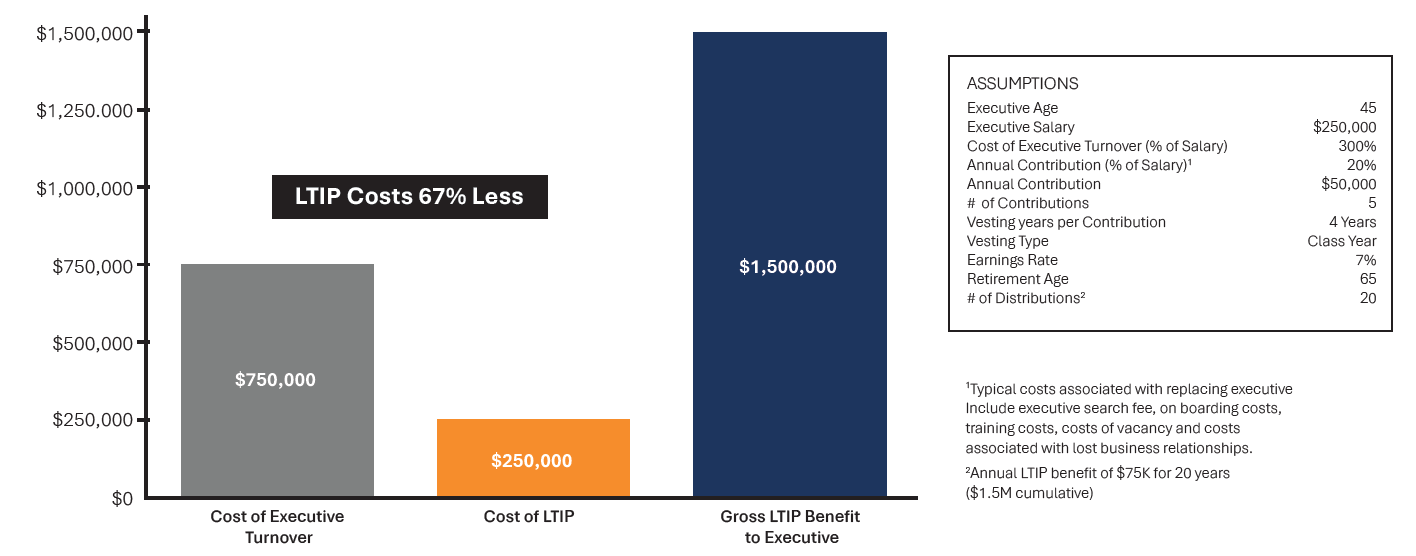
In this example, the company’s LTIP contributions equal half of the assumed turnover cost. The 300% turnover-cost assumption and 67% comparison are used only within this hypothetical illustration and should not be presented as universal benchmarks.
Split Dollar and Long-Term Care
In addition to cash, there can be substantial value in providing executives and their families with valued benefits. The benefits provided would be in addition to traditional employee benefits. Two strategies companies may consider are establishing a split dollar life insurance plan and an executive long-term care plan.
The financial, tax and accounting impact of these arrangements depends on the structure, funding approach, underlying product and applicable rules.
With a split-dollar plan, the company pays the premiums for a life insurance policy, and the death benefit is shared between the company and the individual executive.
An “investment oriented” long-term care insurance plan can provide executives with substantial tax-free benefits in the event they lose two or more daily living activities. The premium is paid for by the company which creates a money market account on the balance sheet of the company. In the event the benefit is not utilized by the executive either because a) they didn’t meet the minimum number of years of service required to receive the benefit or b) they remain healthy, the company will be returned 100%+ of their premiums.
Executive Summary
The true cost of losing an executive equals the summation of the explicit and implicit costs that
arise upon their departure, with the latter representing the most formidable costs, depending upon the quality of talent lost and the quality of the talent acquired.
A company can be much better off creating ways to retain talent rather than taking on the risks of hiring new talent; the known usually outweighs the unknown.
Companies should evaluate the cost of a retention strategy against the potential cost of losing
a key executive, including search, vacancy, transition, lost productivity, business disruption
and relationship risk. Understanding these costs can help leadership determine how much the
organization should reasonably invest to retain executives whose performance, experience and
relationships are critical to the business. Given the potential impact of executive turnover, it
remains important for companies to ask themselves two questions:
-
What can we do to better retain our key people to effectively reduce executive turnover?
-
Is the solution something that is less costly than the economic impact that is created when an executive leaves?
Based on our experience in working with C-level talent and executive teams, it is important for a company to be proactive in understanding the cost formula:
Pay to Stay < Pay to Go
Exploring ways to reduce the impact of executive loss and, moreover, developing plans that
preserve and enhance the long-term enterprise value of the organization should be an important part of every company’s strategic plan.
Executive retention is not simply about keeping people longer. It is about keeping the right leaders invested in the future they are helping build.
Sources:
Russell Reynolds Associates. Global CEO Turnover Index Annual Report 2025. https://www.russellreynolds.com/en/insights/reports-surveys/global-ceo-turnover-index
Work Institute. 2026 Retention Report. 2026.
https://info.workinstitute.com/en-us/2026-retention-report
Gallup. State of the Global Workplace 2026. 2026.
https://www.gallup.com/workplace/349484/state-of-the-global-workplace.asp x
Internal Revenue Service. Publication 525: Taxable and Nontaxable Income. 2025.
See “Split-Dollar Life Insurance.”
https://www.irs.gov/publications/p525
Internal Revenue Service. Instructions for Form 1099-LTC: Long-Term Care and Accelerated
Death Benefits. Revised April 2025.
https://www.irs.gov/instructions/i1099ltc
Please note the above discussion is not intended to be inclusive of all tax code sections that may apply. Mezrah Consulting and its affiliates are not tax professionals, and this document should not be considered tax advice or guidance.
For more information, email Mezrah Consulting at connect@mezrahconsulting.com
or call (813) 367-1111. Visit our website at mezrahconsulting.com to learn more.
Who We Are
Mezrah Consulting, is a national consulting firm based in Tampa, Florida, with more than 30 years of expertise in executive benefits and compensation consulting for over 300 companies throughout the U.S. As subject matter experts, we specialize in designing, funding and administrating nonqualified executive benefit plans while uncovering value and mitigating risks. Our proprietary cloud-based fintech platform, mapbenefits®, provides enterprise plan management for plan participants and plan sponsors. Our focus is on sharing ideas that enable companies and key personnel to accumulate and preserve wealth on a tax-favored basis through innovative solutions and protect their business strategies and financial performance.
Confidentiality
These materials may not be shared with benefit consultants, consulting actuaries, insurance brokers, insurance carriers or others without the specific written approval of Mezrah Consulting. These materials are proprietary, must be kept confidential and are subject to an executed NDA. The materials may be shared with your directors, officers, employees and legal and accounting advisors as needed, provided that such persons are informed as to the confidential nature of the materials and directed by you to treat such information as confidential.
Securities and investment advisory services offered through Integrity Alliance, LLC, Member SIPC. Integrity Wealth is a marketing name for Integrity Alliance, LLC. Mezrah Consulting is not affiliated with Integrity Wealth.
- Tax and Legal services are not offered through Integrity Wealth. This site is published for residents of the United States only. Representatives may only conduct business with residents of the states and jurisdictions in which they are properly registered. Therefore, a response to a request for information may be delayed until appropriate registration is obtained or exemption from registration is determined. Not all services referenced on this site are available in every state and through every advisor listed. Integrity FORM CRS Check the background of this firm on FINRA’s BrokerCheck